Making friends as an adult is a strange business. You can have a good job, a partner and a full calendar and still feel like everyone else was handed a friendship group you somehow missed. The feeling creeps up at odd moments. A quiet Sunday. The school gate, watching other parents chat like they have known each other for years. If that sounds familiar, you are in good company and there is nothing wrong with you. This post looks at why adult friendships get so hard and how something as ordinary as a casual game of football can turn it around.
Why making friends as an adult gets so hard
You might be surprised how common this feeling is. In its survey covering December 2023 to January 2024, the Office for National Statistics found that around a quarter of adults in Great Britain felt lonely at least some of the time. About one in fourteen felt lonely often or always. And here is the part that catches people out. It is not mainly an older person’s problem. ONS data shows younger adults, the group with the most social opportunities on paper, report it most of all.
So why does it happen? Mostly, life simply moves people apart. In your late teens and twenties, friends are everywhere. School, college and those first jobs throw you together with people in the same boat and friendships form almost by accident. As a Psychology Today piece on adult friendship points out, for a lot of us those are the last easy friendships we ever make.
Then real life arrives. Careers, house moves, children, ageing parents, tired evenings. Free time shrinks just as your responsibilities pile up. Friendships are also voluntary, which is exactly what makes them fragile. Family and work have built-in structure, but nobody puts a catch-up in the diary for you. So when two friends are both knackered, neither makes the call and weeks slide into months.
Scrolling does not help either. Social media serves up everyone else’s nights out and group photos, which makes it feel like the whole world has a thriving social life except you. It rarely tells the truth. Most people looking at those posts feel the same quiet pang you do. None of this is a personal failing. It is just the shape of modern adult life and the good news is that it can be changed.
So how do you actually make friends as a grown-up?
The research is more reassuring than you might expect. The advice tends to come down to a few simple things. Stop waiting to be invited and be the one to suggest the plan. Invest in your “weak ties”, the familiar faces you see often, because small regular contact does more for your wellbeing than the odd big occasion. And, as one psychology professor told his students about finding friends at university, “just keep showing up”.
Sound, all of it. There is just one catch. Initiating, organising and showing up again and again takes effort and energy, which is the very thing tired adults are short of. That is where a regular football game quietly does the heavy lifting for you.
6 simple ways football helps making friends as an adult
1. The plan is already made
The hardest part of adult friendship is being the one to suggest something. A football game removes that entirely. The fixture happens whether you organise it or not, so you just pick a night and turn up. No group chat to start. No awkward ask, no risk of being turned down.
2. You see the same faces every week
Friendship grows through repetition far more than grand gestures. Psychologists even have a name for it, the mere exposure effect, which is the simple fact that the more we see someone, the more we tend to warm to them. A weekly game on the same pitch, with a lot of the same players, builds that familiarity without anyone trying. The strangers from week one become the people you save a spot for by week six.
3. It turns small talk into real ties
Those nodding acquaintances, the weak ties researchers make such a fuss about, are easy to collect on a pitch. You share a groan over a missed sitter, then a quick chat in the car park afterwards. Do that a few weeks running and some of those light connections quietly grow into proper friendships. You barely notice it happening.
4. You are on the same team within minutes
Making conversation from a cold start is hard work. Football hands you a reason to talk before you have even spoken. You get put on a side, you both want the same result and suddenly you are shouting for a pass like you have played together for years. Shared purpose does the job that stilted introductions never can.
5. No team, no skill, no pressure
You do not need to bring anyone and you do not need to be any good. At Football for All you book as an individual, the teams are sorted on the night and complete beginners play alongside people coming back after years away. Because the bar to simply turning up is so low, it is easy to keep coming back. That is half the battle won.
6. Someone is there to welcome you
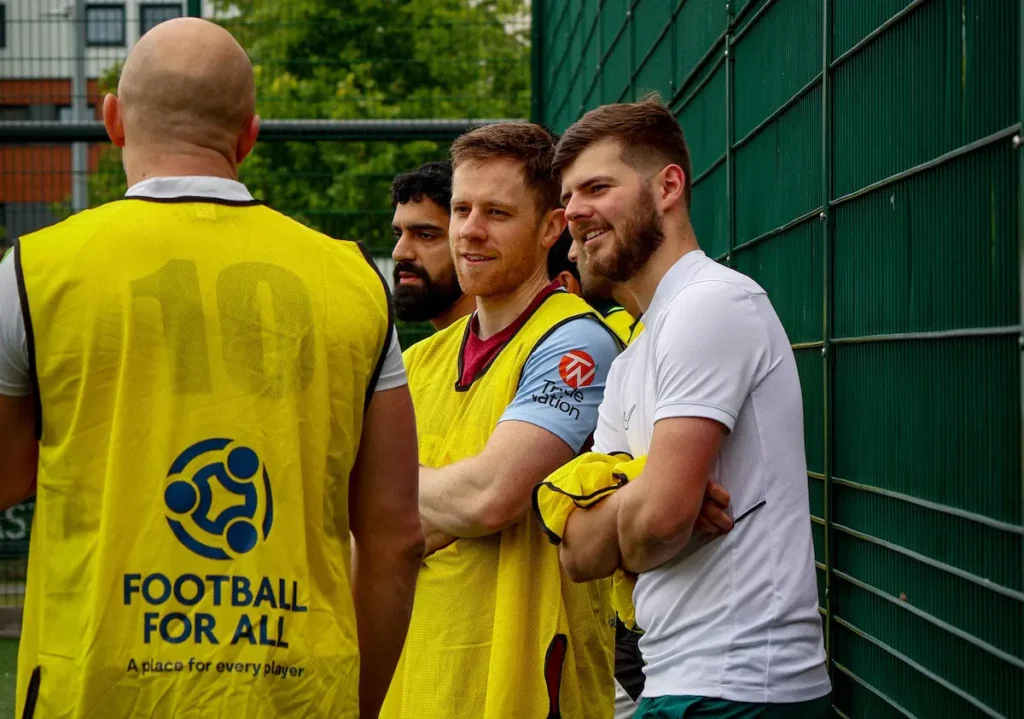
Walking into a room full of strangers is daunting for almost everyone. So every Football for All game has a friendly host who greets you, hands you a bib and slots you into a team. You are never the lost new person hovering on the edge. From the first whistle you are simply another player and nobody is checking your CV.
What a Football for All game is actually like
Picture a Tuesday evening. You have found a game near you, booked your spot in about thirty seconds and turned up not knowing a soul. The host says hello, throws you a bib and points you towards your team. The games are small-sided, usually 6-a-side or 8-a-side on a floodlit 3G or 4G pitch and they last around an hour. There are no referees and no coaches barking from the touchline, just a friendly bunch of local people enjoying a game. By the final whistle you have picked up a few names, shared a couple of laughs and, more often than not, found a reason to come back next week.

There is real substance behind the good mood, too. Dr Harry Costello, a psychiatrist who plays in our sessions, makes the point that if a team sport like football could be bottled as medicine, doctors would hand it out on prescription. NHS practitioners we work with have recorded an average 80% improvement across 14 wellbeing measures for people in our games. Connection, it turns out, is genuinely good for you.
We are a non-profit and we run inclusive games across England, Scotland and Wales, often in the communities that need that bit of extra connection the most. If you have just moved somewhere new, football can be one of the fastest ways to feel at home and find your people.
How to find football games near you and book your first one
Getting started is the easy bit. We organise every game through Footy Addicts, the social football platform that has been connecting players with local games since 2013. The whole model comes down to three words. Find, book, play. Pick your area, choose a game that suits your week and tap to join. Most games cost around £5, paid per game, which covers the pitch, the bibs and your host. There is no membership and no season to sign your life away to.
If you want it step by step, our guide on how to find football games near me walks through the lot. We also run women-only games through the Football for All Women programme, so there is a comfortable way in for everyone.
A simple place to start making friends as an adult
Making friends as an adult was never meant to be this hard. Most of us are not short of warmth or good company. We are just short of easy, regular places to find it. A weekly kickabout is one of the simplest ways back in. You show up, you play, you keep showing up and the friendships tend to look after themselves.
So here is something worth sitting with. Where in your week could you turn up often enough for the people there to start feeling familiar? If a pitch sounds like a good place to begin, come and find your game. We would love to see you there.